

The first time I came across this concept was from a TeachersPayTeachers creator IdeasbyJIvey If this is your first foray into Mentor Texts, I high recommend starting with her collections. Most of the books can be found in your local library, if you’re not into buying a ton of books, and, even more, can be found read online for free on Youtube, as well. While the teacher in me wants the book (with grabby hands, no joke! I have an addiction to books, it’s fine. Everything’s fine.), I have also used the read aloud videos on Youtube when money was tight and it worked beautifully. You can embed the Youtube videos into presentations for use with these, too, so adding a little extra technology can be a good thing!
What are Mentor Texts
Mentor Texts are simply any book that gets you excited about reading. Whether it’s fiction or non-fiction doesn’t matter. You can use picture books the whole time, even with High Schoolers! In fact, I recommend it, because they’re usually entertaining AND SHORT! You can tailor book choice to any topic you’re working on in grammar or content teaching. Want to talk about adjectives? Dr. Seuss is the king of them! What do discuss voice? Try Because of Winn Dixie by Kate DiCamillo (it’s not a picture book, but the chapters are short and it doesn’t take long to pick up on the voice).
The possibilities are endless! You can even pick passages that ARE NOT written well!
The key is to discuss what is done well (or not done well) and replicate the technique. Please note, I didn’t say replicate the sentences or even the story structure. It’s the technique you’re after, here.
How do I focus on technique in a whole book?
That, my friends, is the easy part. If it’s a picture book, pull your technique from the text and discuss it. One of my favorites is to discuss letter writing and use Dear Mrs. La Ru, by Marc Teague. It’s a great start to a unit on letter writing, in fact. Start with format, discuss salutations, closings, signatures, and all that loveliness. Then move into content, how is the letter built? Is there a review of previous discussions before it introduces a new topic? How is it built different than a normal paragraph styled story? While you’re at it, throw another Mentor Text in there, this time as a book study: Dear Mr. Henshaw by Beverly Cleary! Compare the formats, discuss the content, then have them write their own friendly letter!
Mentor Sentences, then?
Here’s where the work is, my friends. My lovely walking mentor text (JIvey, she doesn’t know it, yet, but I love her to bits), has created a repetitive activity that is done each day of the week, regardless of the text.
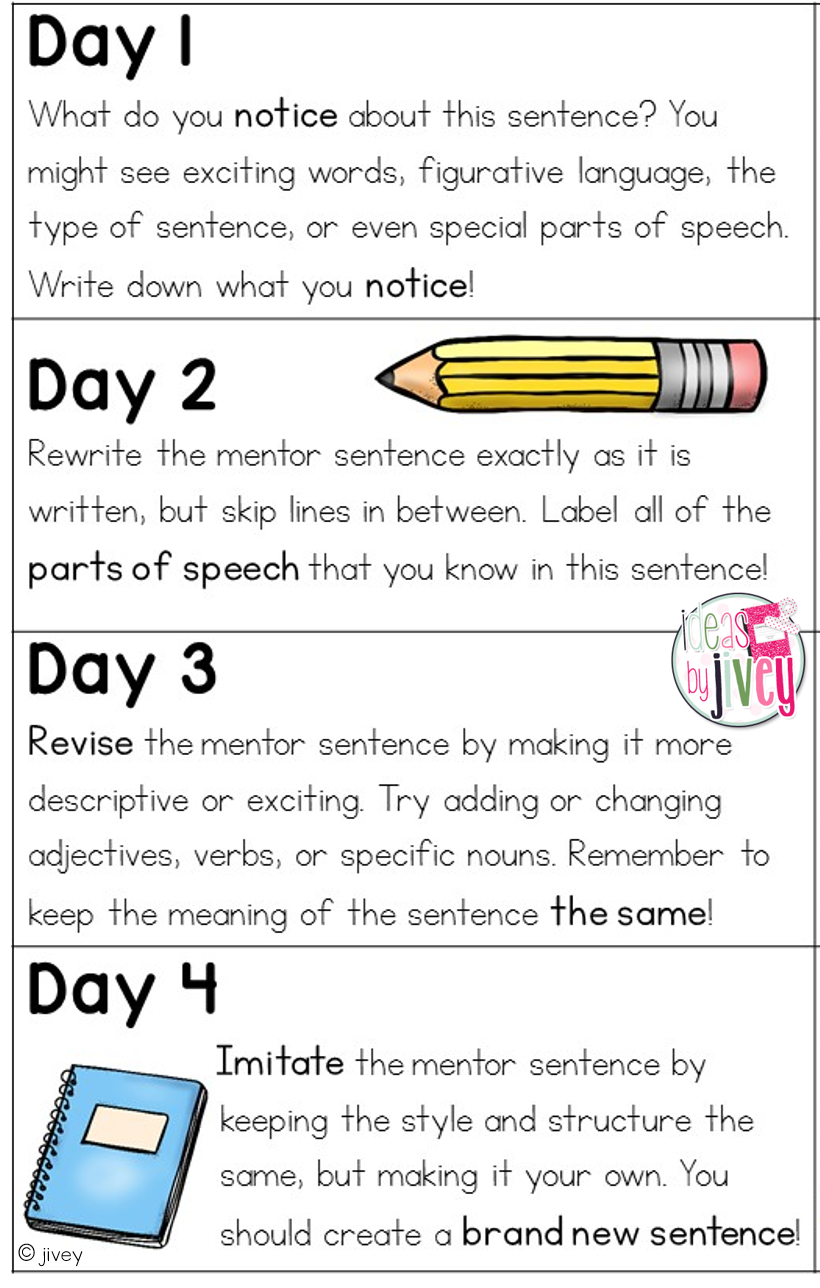
Monday is the Invitation to Notice, where students are presented the sentence and their job is to “notice” what’s going on in the sentence. The idea here is to ensure the students see the technique being used by focusing on a sentence in which the technique happens. This can be anything from past tense verbs to punctuating dialogue, with a side order of word choice! Have the students document what they see and come back to it during the week.
Tuesday is the Invitation to Identify. I plussed (a word I created by stealing the “How can we plus this?” idea from Walt Disney) this by having students identify parts of speech based on what purpose the words are serving in the sentence, and not just “it’s an action, so it has to be a verb.” I use the fact that I literally created a verb out of a noun to describe what we’re doing, here and my spellcheck is telling me it’s not a word, but I use it anyway. Oh, an all of Dr. Seuss is made up words (makes them great to use for parts of speech, since they can’t identify the words and have to use the context to figure out what’s going on!) so there ya go! I’m more interested in PURPOSE.
Wednesday is the Invitation to Edit, where students are given the same sentence with a whole bunch of mistakes. If you remember the old days of Daily Oral Language, this is where it is. You ask them questions about the technique and give them extra practice with the technique. Depending on what you’re using it for, this can be a set of about 5 words where they have to write the past tense versions on the chart, or a few incorrectly punctuated sentences that need some corrections. The goal here is for them to identify the technique and apply it to practice pieces.
Thursday is the Invitation to Revise, where students get to revise the sentence and help the author with grammar and word choice. Add descriptive adjectives, specific nouns, vivid verbs to the given sentence. Discuss all the different ways you can make the sentence “better” or “more interesting.” Have fun with it!
Friday is the Invitation to Mimic, where students build their own sentences using the technique of the mentor text. Focus specifically on the technique discussed this week here! Let students read them aloud to each other! The feedback is the important part!
Make it yours!
Now, I will throw in that I changed this up a bit to help my kids work on their writing. I combined Monday and Tuesday into the same day, left Wednesday’s activity alone but did it on Tuesday, and backed Thursday and Friday’s activities up a day. This left me with Friday open, so I created Invitation to Finish, where students take the sentence they created on Thursday and finish the paragraph! My goal with this was for them to continue the topic they wrote on and get practice expounding on it. We left this as a rough draft and added them to our writing notebooks!
The beautiful part about this is that you can tweak this until it fits your class’s needs. It can be part of a warm up, part of the morning circle time, part of Reading, part of a center. You can print these out, have students copy them, color code them, or make them interactive with sticky notes or labeled stickers. If you can think of a way to make this yours, DO IT! 🙂 As always, MAKE IT FUN!
Quick Note About My Writing Journals:
Every Friday, students chose one of the rough drafts they’ve written this week (from a lot of different sources), then revise and edited it until they had a piece that they wanted to publish. The Published piece was graded as a weekly quiz, where one part of the score was the correct implementation of the technique we’d been studying!
So, there you go!
Check out JIvey’s blog for more information, because she does a much better job at this than I do!
Until next week!
~Mrs. F
 Welcome to The Franklin Academy